
|
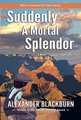
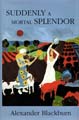
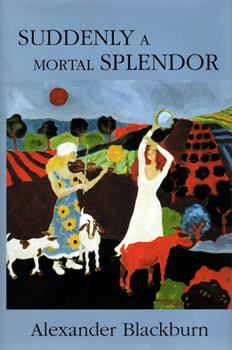
SUDDENLY A MORTAL SPLENDOR Suddenly a Mortal Splendor is the story of a man’s search, amidst the chaos and ideological violence of wars and revolutions in the second half of the twentieth century, for a faith to live by in life itself. Paul’s father in Hungary had been enslaved by the Fascists and driven to suicide by the Comunists. He, himself, from the age of five, has been separated from his father and forced into a state-run orphanage for indoctrination. While Paul’s love of freedom saves him, his friend Günter, a victim of sexual abuse, develops a mirage personality, one that will eventually convert him into a mass executioner in the dictatorship of a Latin American country. Freed from the school, Paul, together with his mother, tries to escape to the West during the revolution of 1956; he succeeds in reaching Austria, but she is murdered by Russian guards at the border. There in Austria Paul is unofficially adopted by a rich Englishwoman, Grace Woolpack, who gives him a home in London. Little does he realize that she intends to use him in a game to secure control of her husband’s American family’s multinational corporation. When, however, she seduces Paul, he absconds with and marries Woolpack’s pregnant mistress, a politically radicalized, crippled American girl who has been banished from her own home in the States. As stepfather to Bluejean’s child, Christina, Paul, now a “lifer” in the Army, flourishes in parental love for years, but suddenly, just before Paul returns from a disastrous military tour in Vietnam, Bluejean, ever at the beck and call for Woolpack, does something she has never done before: running off to join him in Pacífica, a country in the throes of a coup, she has taken Christina, aged ten, with her. Upon learning that Bluejean is “disappeared” -- she has been murdered by Günter -- Paul flies to Pacífica in hopes of saving Christina, the person he lives for. Find her, he does, but Grace, allied with the country’s dictator, has taken her hostage, release contingent upon a heavy ransom: Woolpack, once back in America, must die. And now Paul lives in an agony of anxiety, his quest for the humane in humanity seemingly at a dead end because, he believes, Woolpack loves only himself, not his daughter. And yet, years later, Woolpack proves him wrong when he deliberately sacrifices his life to redeem Christina from captivity. This “mortal splendor” of a fully compassionate human being gives Paul the absolute faith in life he has always sought. There is one more realization: Woolpack who had since childhood harbored a hope to save the planet itself, beauty epitomized by the Grand Canyon, from the sorrows of ecocide. “ I finished reading it last night and thank you for a raucous, yet serious ride. You have miraculously jammed into 300 mere pages some half- dozen cultures, three continents, and three wars, sex, danger, perversion, honor, and more." – Donald Anderson, Editor-in-Chief, War, Literature & the Arts "Alexander Blackburn has earned our serious attention." –Reynolds Price, novelist, poet, playright, winner of the New York Critics Circle Award "Suddenly a Mortal Splendor is a beautiful, intelligent, and wonderfully crafted novel, a novel epic in its scope and landscape and imagination. What Alexander Blackburn has done here is nothing less than a miracle; in a time when contemporary novels are indistinguishable from daytime talks shows, he has given us a world resplendent with ideas and actions and blood and love and the land. This is an important book that will last." -- Bret Lott, novelist, story writer, author of the best-selling novel, Jewel, and formerly Director of The Southern Review Blackburn tears off a great hunk of late 20th century history to use as a source of inspiration and moral instruction. He writes with savage humor about man’s limitless capacity for inhumanity and equally limitless capacity for survival… The bravado of its romantic hero is matched by the bravado of an author who dares to offer a full-scale picaresque adventure in an age of miniaturization." – Amanda Heller, Boston Globe “ It is a tribute to Blackburn’s craft that the theory underlying his novel nourishes the deep structure of the book without ever impinging on its vitality, humor and moral weight....Blackburn’s novel is a chronicle of life lived as a pattern of fictions, a recognition that some fictions are truer than others, and that the only “non- fictional” identity we may be able to achieve is that of a conscientiously selected set of fictions by which we best can live with each other. This, Blackburn seems to imply, is the way out of the picaresque dilemma, a literal reading of which might insinuate we are doomed to alienation, pointless wandering, the vagaries of human unkindness, and a permanent outsider status on the periphery of a hollow society. Ultimately, Blackburn in Suddenly a Mortal Splendor offers as radical sense of optimism as could be hoped for at the end of the current millennium, a vision that from a survivor’s perspective, nuclear blasts and other manmade human catastrophes can be as beautiful as they are devastating, and that mass destruction and human cruelty and depravity can be made meaningful only by our reaction against it, by our personally breaking tragic cause and effect chains which steer us away from oblivion and toward less cataclysmic non-fictional realities.”--Tracy Santa, The United States Air Force Academy, currently at Colorado College. |
 Summary